On Wednesday 11th December Laura Colini and Lorenzo Tripodi will take part as discussants to a one-day symposium celebrating the work and books of renowned Swiss geographer Christian Schmid.
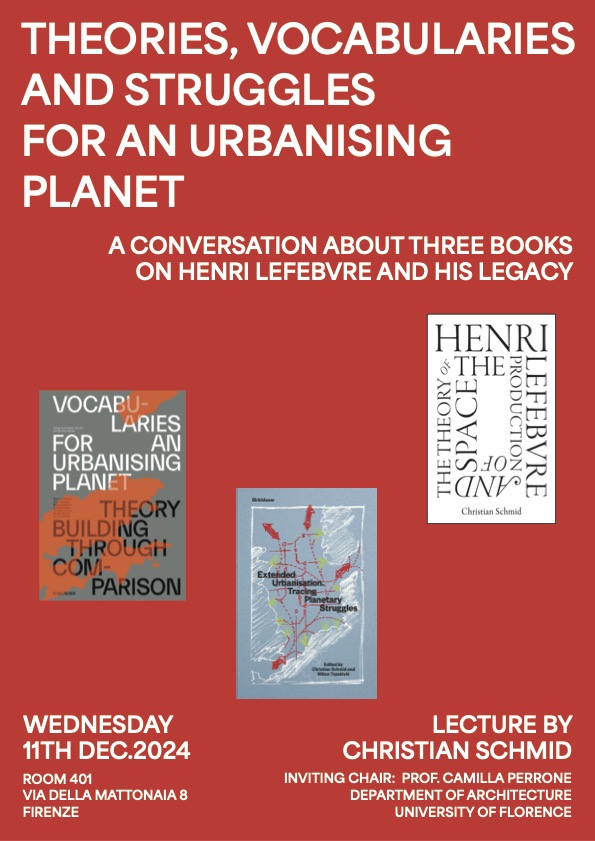
This conference is an opportunity to engage in a dialogue with one of the world’s leading experts on Lefebvre and his legacy, and a group of scholars, independent researchers and practitioners inspired by Lefebvrian thinking. Most of all, the conference offers the chance to critically focus on fundamental research challenges, both ntheoretical and practical, and to discuss new perspectives on the urbanisation of this Millennium. The conference is organised around the presentation of three books: Henri Lefebvre and the Theory of the Production of Space (authored by Christian Schmid), Vocabularies for an Urbanising Planet: Theory Building through Comparison (edited by Christian Schmid and Monika Streule) and Extended Urbanisation: Tracing Planetary Struggles (edited by Christian Schmid and Milica Topalović). Building on Lefebvre’s theory, the three books show possible applications and further developments in theory, research and practice. They call for a radical shift in the analytical perspective on urbanisation, and offer a redefinition of the very notions of the vocabulary of urbanisation processes through a comparison of Tokyo, Hong Kong/Shenzhen/ Dongguan, Kolkata, Istanbul, Lagos, Paris, Mexico City and Los Angeles and allow us to assess the practical consequences of different urban strategies in everyday life. They also explore different processes of extended urbanisation in eight world regions, where urbanisation processes unfold far beyond the realm of agglomerations, profoundly transforming agrarian areas, rain forests, deserts and oceans. In this way, these books drive critical thinking, allow to decipher the rapidly changing urban territories across the planet through a novel cartography and detailed ethnographic and historical explorations, and outline new urban agendas developed to address urgent contemporary planetary challenges.
Christian Schmid is a geographer und urban researcher. He is Professor for Sociology at the Department of Architecture, ETH Zürich. His scientific work is on planetary urbanisation, on comparative urban analysis, and on theories of urbanisation and of space. He is a founding member of the International Network for Urban Research and Action (INURA). He wrote an encompassing reconstruction of Henri Lefebvre’s theory of the production of space published by Verso in 2022. Together with architects Roger Diener, Jacques Herzog, Marcel Meili and Pierre de Meuron he co-authored the book “Switzerland: An Urban Portrait” (2006), a pioneering analysis of extended urbanisation.
Program
FLORENCE, 11 DECEMBER 2024: CONVERSATION AND BOOKS EXHIBITION
ROOM 401, VIA DELLA MATTONAIA 8, FIRENZE
10.00-10.15 Institutional Welcoming by Giuseppe Lotti, Director of PhD course on Sustainability and Innovation and Giulis Pili, Director of the Technology Library,
10.15-10.30 Introduction: Camilla Perrone (Unifi)
10.30-11.15 Henri Lefebvre and the Theory of the Production of Space (Authored by Christian Schmid, Verso, 2022): book launch and conversation
Book introduction by Christian Schmid
11:15 – 11:30 Break
11:30-13.00 In conversation with Luca Gaeta (Polimi), Barbara Pizzo (RomaTre), Lorenzo Tripodi (Tesserae)
Audience reactions (PHDs, Master Students etc.)
13:30 – 14:30 Lunch
14.30-16.00 Vocabularies for an urbanising planet: Theory building through comparison (Edited by Christian Schmid and Monika Streule, Birkhäuser, 2023): book launch and conversation
Book introduction by Christian Schmid, in conversation with Valeria Fedeli (Polimi), Raffaele Paloscia (Emeritus Unifi), David Fanfani (Unifi)
Audience reactions (PHDs, Master Students etc.)
16:00 – 16:30 Break
16.30- 18.00 Extended urbanisation: Tracing planetary struggles (Edited by Christian Schmid and Milica Topalović, Birkhäuser, 2023): book launch and conversation
Book introduction by Christian Schmid, in conversation with Laura Colini (IUAV), Marvi Maggio (previous Tuscany Region), Maddalena Rossi (Unifi), Iacopo Zetti (Unifi)
Audience reactions (PHDs, Master Students etc.)
18.00-18.30 Open discussion about future agendas for research and action